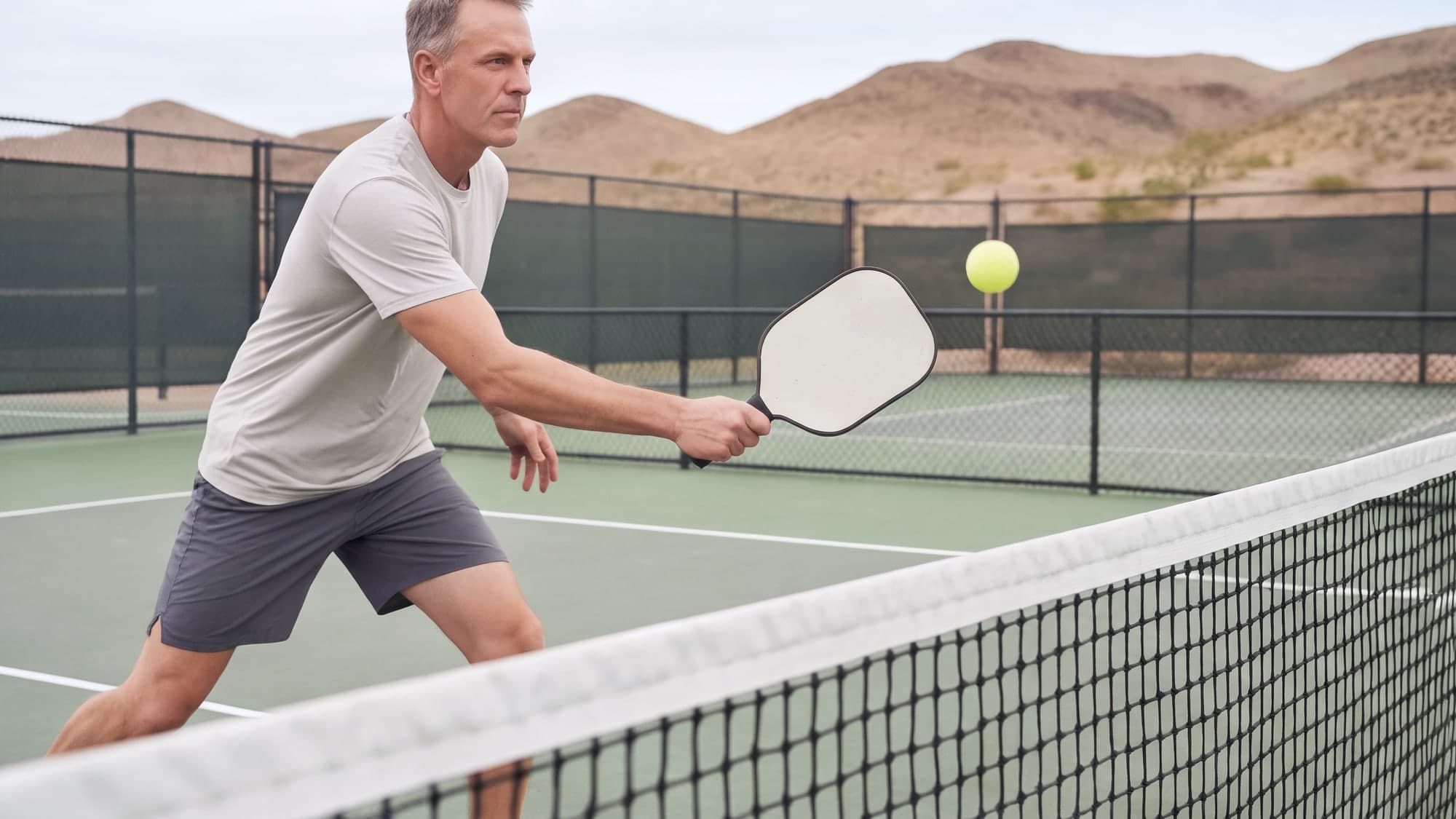
Las Vegas plays pickleball all year. Courts in Henderson, Summerlin and Boulder City fill up by 7 a.m. in June, and the same players are back under the lights after work. A sport this social and this easy to start also asks a lot of an adult body that may not have played anything in twenty years.
This article is general information. It explains what players mean when they search for the common strains, lists the everyday basics most active adults pay attention to, and shows how the GIOSTAR Recovery Membership fits into a playing week. It does not diagnose anything. A provider does that.
What players mean by common pickleball injuries
Pickleball is a small-court sport with short, fast exchanges. Players reach, twist, lunge and stop suddenly, and they repeat the same swing hundreds of times in a session. When people search for pickleball injuries, they usually mean one of four areas.
- Elbow. Many players describe a sore spot on the outside or inside of the elbow after long sessions. The common names are tennis elbow and golfer's elbow, and our guide to golfer's elbow and tennis elbow explains what each name refers to.
- Shoulder. Overhead smashes and long reaches put the shoulder to work. Players search for shoulder soreness after a stretch of heavy playing.
- Wrist. The paddle grip and a lot of quick wrist snaps lead many people to search for wrist strain.
- Knee. Quick stops and side-to-side steps ask a lot of the knee. This is a common search among newer players who came to the sport later in life.
Those are names people use for how a body feels after play. They are not a diagnosis. Only a provider who examines you can say what is going on in a particular elbow, shoulder, wrist or knee.
When pickleball pain needs a doctor first
New, sharp or sudden pain deserves a visit with a doctor before anything else. The same goes for swelling, a joint that gives way, numbness or tingling, or pain that keeps getting worse. Those are not signs to work around with a plan or a membership. See a physician or an orthopedic provider first.
Once a doctor has looked at you, a wellness plan can sit alongside whatever they advise. That is the lane where GIOSTAR works: supporting an active life, built on your own information.
Everyday basics for pickleball players in Las Vegas
Most active adults already know the basics. They matter more in a desert city than they do in most places.
- Fluids. Court surfaces in July reflect heat back at you. Carry water to every session and drink before you feel thirsty.
- Sleep. A late-night league followed by a 7 a.m. game adds up over a week.
- Warm-up. A few minutes of easy movement before the first rally beats starting at full speed.
- Strength work. Players who add simple strength work for legs, shoulders and the grip often feel more ready for the next game.
- Equipment. Paddle weight, grip size and shoes that suit the court all matter. A pro shop or a coach can help you fit them.
- Rest days. Hard sessions on back-to-back days leave less room to bounce back than most people expect.
None of this is a promise about your body. It is what most players, coaches and physical therapists talk about when you ask how to stay on the court.
How the Recovery Membership supports pickleball players
The Recovery Membership at GIOSTAR is built for people who plan their weeks around staying active. It includes monthly IV infusion credits, a discount on additional IVs and biomarker testing. You choose among the drips on our menu with your nurse practitioner: Hydration IV, Immunity Boost IV, Performance & Recovery IV and the Myers Cocktail.
Performance & Recovery IV carries amino acids and electrolytes and is built for active people. Hydration IV is balanced fluids and electrolytes, a plain choice for a summer court week. A licensed professional places every IV at our Henderson wellness center, in a recliner, and a drip usually takes about an hour. Our IV therapy overview lays out each drip and how a visit runs.
If you compete in a tested event, check with your governing body before any treatment.
Why bloodwork shapes a pickleball recovery plan at GIOSTAR
A plan is better when it starts with your information. The Diagnostic Lab Panel covers hormone, metabolic and biomarker bloodwork: 100+ biomarkers from one morning draw at a Quest location near you. Results come back in about a week, and a nurse practitioner reviews every marker with you. Bloodwork is a paid service, and your nurse practitioner confirms your total before you book.
Your plan can then be matched to your schedule. A player in three leagues has a different week than someone who plays on Saturdays. Our full-body blood panel guide shows what the panel measures.
Starting a pickleball recovery plan at GIOSTAR
Begin with the free initial visit with a nurse practitioner. You talk through your history, your playing schedule and your goals. If bloodwork makes sense, your nurse practitioner may recommend it. From there you decide together whether the Recovery Membership suits your week.
Pickleball recovery support at GIOSTAR in Henderson
GIOSTAR stands for Global Institute of Stem Cell Therapy and Research. Founded by Dr. Anand Srivastava, GIOSTAR International is part of a network across three countries, built on research at Salk, UC San Diego, UC Irvine and UCLA. Our Henderson wellness center is at 2482 W. Horizon Ridge Pkwy, Ste 100, Henderson, NV 89052, with private treatment rooms, an IV lounge with recliners and free parking at the door.
Your first step is a free consultation with our patient team, online, by phone at 702.703.5393 or in person. Read more about the Recovery Membership for pickleball players or about IV therapy at GIOSTAR.