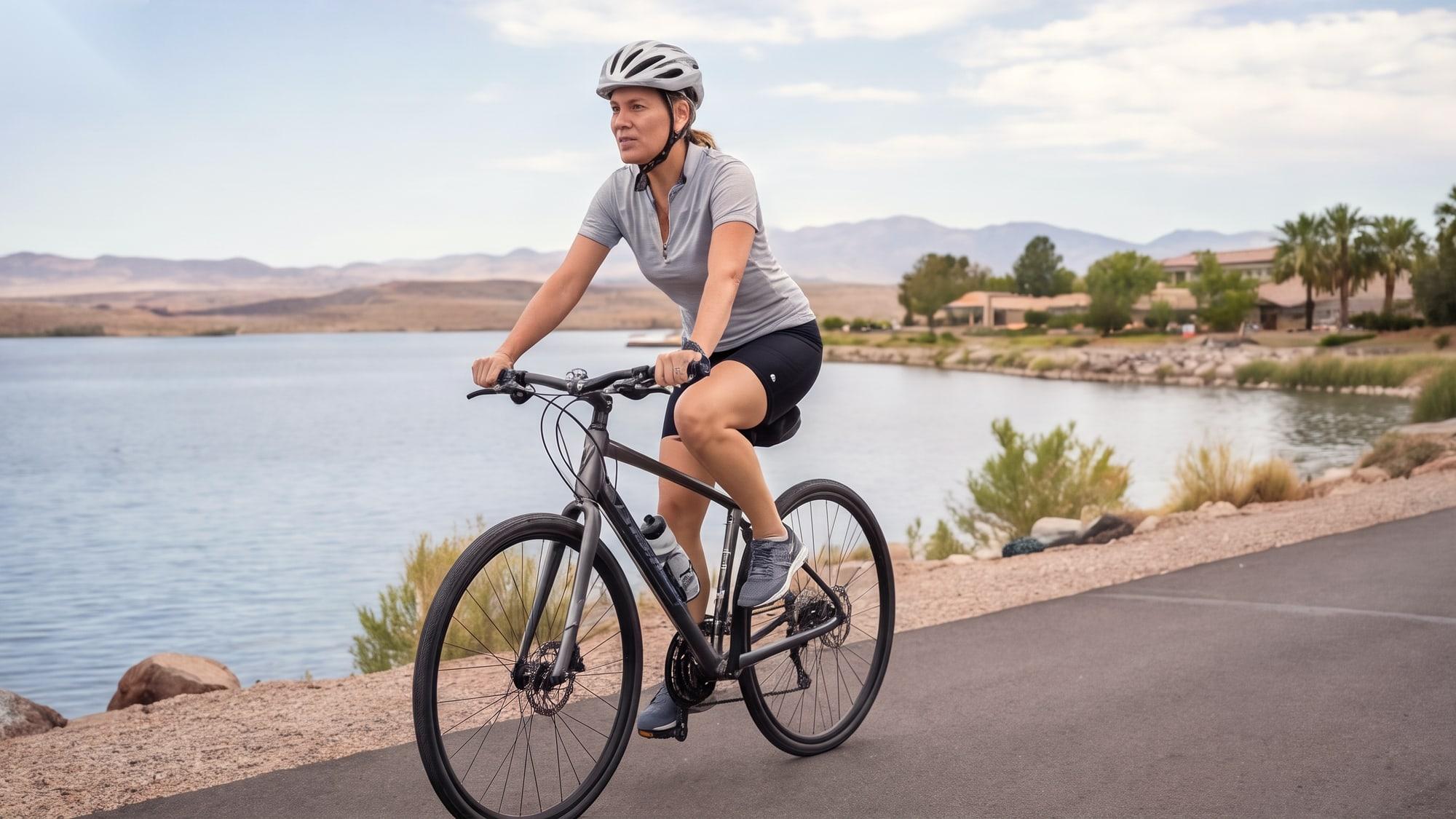
Cyclists spend hours in one position, folded over a frame with their hands out front. Out on Red Rock Canyon Loop or up Lee Canyon, that position gets long. Lower back soreness is among the most common things riders ask about, and the search is busy. This article explains what riders usually mean by it, shares general notes on bike fit, core strength and ride volume, and describes how a peptide program at GIOSTAR is planned. It is general information, not a diagnosis.
What riders mean by lower back soreness from cycling, and where GIOSTAR fits
The phrase usually describes an ache or tightness across the lower back that shows up during or after a long ride. Cycling holds the torso in a flexed, forward position while the legs work, and the lower back carries a share of that load for as long as you ride.
A provider diagnoses the cause of back pain. A peptide program is not a diagnosis and is not an answer to pain. It is a plan built by a provider around your goals and your bloodwork, for adults who want to stay active. See a doctor first for pain that is new or sharp.
General notes on bike fit, core strength and ride volume for cyclists
Several ordinary things shape how a back feels after a ride. They are general information, not advice for your back.
- Bike fit. Saddle height, reach, handlebar height and crank length change how you sit. A professional bike fit is a common step for riders who log long miles.
- Core and hip strength. Many riders add strength work for the trunk and hips off the bike. A coach or physical therapist can tailor it.
- Ride volume. A jump from short weekday spins to a 60-mile Saturday asks more of the body than a gradual build.
- Position changes. Moving your hands, standing for a few pedal strokes and shifting on the saddle are habits many riders use on longer rides.
- Heat. Summer riding in the valley is usually an early start for a reason.
If your back pain is new, sharp, or travels into a leg, see a doctor before anything else. That advice outranks the rest of this article.
How a GIOSTAR peptide program is built for riders who want to stay active
The Peptide Optimization Membership is made up of custom peptide protocols chosen and dosed by a provider after bloodwork, from a licensed pharmacy, with training on how to self-inject. Your provider explains each part of your protocol at your visit.
Recovery and staying active come up as goals a plan is built around. A cyclist might tell the nurse practitioner: I ride four days a week, I do one long ride on weekends, and I want a plan from a provider who sees my labs. The nurse practitioner reviews the goal against the rider's history and medications. For the longer explanation, read what peptide therapy is and how it works.
The bloodwork behind a cyclist's peptide program
Every plan starts with labs. The Diagnostic Lab Panel covers 100+ biomarkers in one morning draw at a Quest location near you. Results come back in about a week, and a nurse practitioner reviews every marker with you. A panel does not diagnose a back and does not choose a protocol by itself. It gives you and your provider a shared starting point. Read what a full-body blood panel measures.
How a peptide program visit runs for a rider
- Free consultation. You talk with our patient team, with no obligation.
- Visit with a nurse practitioner. Health history, goals, medications and your weekly ride schedule.
- Bloodwork. One morning draw at a Quest location near you.
- Your plan. When it is medically appropriate, your nurse practitioner chooses and doses your protocol and trains you to inject at our Henderson wellness center.
- Follow-up. About every 3 months we recheck your labs and review how the plan is going.
What to bring to a peptide program visit if you ride
Bring your medicines and supplements with doses, a short account of your riding week, any back concerns and how long you have had them, and your questions about storage, injection and cost. If you race in events with testing rules, check with your governing body before any treatment and tell your provider at the consultation. If you take hormone medication, your provider reviews it alongside any peptide plan. See how hormone therapy works.
When cycling back soreness needs a doctor first, before any GIOSTAR plan
Some things should not wait for a wellness plan. See a doctor first for back pain that is new or sharp, for pain that spreads into a leg, for numbness or weakness, or for soreness that does not ease with rest. Your nurse practitioner will say the same and will send you to the right provider. Once a doctor has looked at you, a wellness plan can sit alongside their advice.
Peptide programs for cyclists at GIOSTAR in Henderson
GIOSTAR stands for Global Institute of Stem Cell Therapy and Research. Founded by Dr. Anand Srivastava, GIOSTAR International is part of a network across three countries, built on research at Salk, UC San Diego, UC Irvine and UCLA. Our Henderson wellness center is at 2482 W. Horizon Ridge Pkwy, Ste 100, Henderson, NV 89052, with free parking at the door.
Your first step is a free consultation with our patient team, online, by phone at 702.703.5393 or in person. Read more about peptide therapy at GIOSTAR, see peptide recovery programs, or read what to ask a provider about peptide therapy.